Kapasitor
- Tempo Kapasitor (komponén) pikeun bahasan tipe husus.

Kapasitor nyaéta parangkat listrik nu bisa nyimpen énérgi dina médan listrik antara sapasang konduktor nu jarakna deukeut (disebut 'pelat'). Nalika voltase diterapkeun kana kapasitor, muatan listrik kalayan gedé nu sarua, tapi polaritas atawa kutubna béda bakal diwangun dina unggal pelat.
Kapasitor digunakeun dina sirkuit listrik minangka alat panyimpen
énérgi. Bisa ogé digunakeun keur misahkeun sinyal frékuénsi luhur jeung
frékuénsi handap sarta ngajadikeunnana bisa dipigunakeun dina filter
éléktronik.
Kapasitor kadang-kadang disebut kondénsator. Istilah ieu dianggep istilah baheula.
Fisik
Sawangan
Kapasitansi kapasitor
Kapasitansi kapasitor (C) nyaéta ukuran muatan (Q) nu kasimpen dina unggal pelat pikeun hiji béda poténsial atawa tegangan (V) nu mucunghul antara pelat-pelat éta:

Dina hijian SI, kapasitor mibanda kapasitansi safarad lamun sacoulomb muatan nyababkeun béda poténsial savolt
pikeun sakabéh pelat. Kusabab farad téh mangrupakeun hijian nu kacida
gedéna, ajén kapasitor biasana diungkabkeun dina microfarad (µF),
nanofarad (nF) atawa picofarad (pF).
 |
Artikel ieu keur dikeureuyeuh, ditarjamahkeun tina basa Inggris. Bantosanna diantos kanggo narjamahkeun. |
The capacitance is proportional to the surface area of the
conducting plate and inversely proportional to the distance between the
plates. It is also proportional to the permittivity of the dielectric (that is, non-conducting) substance that separates the plates.
The capacitance of a parallel-plate capacitor is given by:
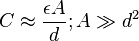
where ε is the permittivity of the dielectric, A is the area of the plates and d is the spacing between them.
In the diagram, the rotated molecules create an opposing electric
field that partially cancels the field created by the plates, a process
called dielectric polarization.
Enérgi nu kasimpen
As opposite charges accumulate on the plates of a capacitor due to
the separation of charge, a voltage develops across the capacitor owing
to the electric field of these charges. Ever-increasing work must be
done against this ever-increasing electric field as more charge is
separated. The energy (measured in joules, in SI)
stored in a capacitor is equal to the amount of work required to
establish the voltage across the capacitor, and therefore the electric
field. The energy stored is given by:

where V is the voltage across the capacitor.
The maximum energy that can be (safely) stored in a particular
capacitor is limited by the maximum electric field that the dielectric
can withstand before it breaks down. Therefore, all capacitors made with
the same dielectric have about the same maximum energy density (Joules
of energy per cubic meter).
Modél hidrolis

As electrical circuitry can be modeled by fluid flow, a capacitor can be modeled as a chamber with a flexible diaphragm
separating the input from the output. As can be determined intuitively
as well as mathematically, this provides the correct characteristics
- The pressure across the unit is proportional to the integral of the current
- A steady state current cannot pass through it but a pulse or alternating current can be transmitted
- the capacitance of units connected in parallel is equivalent to the sum of their individual capacitances
- applying too much pressure, above the maximum breakdown pressure, will destroy it.
Kapasitor dina sirkuit listrik
Sirkuit kalayan sumber DC
Electrons cannot easily pass directly across the dielectric from one
plate of the capacitor to the other as the dielectric is carefully
chosen so that it is a good insulator. When there is a current through a
capacitor, electrons accumulate on one plate and electrons are removed
from the other plate. This process is commonly called 'charging' the
capacitor -- even though the capacitor is at all times electrically
neutral. In fact, the current through the capacitor results in the
separation of electric charge, rather than the accumulation of electric
charge. This separation of charge causes an electric field to develop
between the plates of the capacitor giving rise to voltage across the
plates. This voltage V is directly proportional to the amount of charge
separated Q. Since the current I through the capacitor is the rate at
which charge Q is forced through the capacitor (dQ/dt), this can be
expressed mathematically as:
-

where
- I is the current flowing in the conventional direction, measured in amperes
- dV/dt is the time derivative of voltage, measured in volts per second.
- C is the capacitance in farads
For circuits with a constant (DC) voltage source, the voltage across
the capacitor cannot exceed the voltage of the source. (Unless the
circuit includes a switch and an inductor, as in SMPS, or a switch and some diodes, as in a charge pump).
Thus, an equilibrium is reached where the voltage across the capacitor
is constant and the current through the capacitor is zero. For this
reason, it is commonly said that capacitors block DC current.
Sirkuit kalayan sumber AC
The capacitor current due to an AC
voltage or current source reverses direction periodically. That is, the
AC current alternately charges the plates in one direction and then the
other. With the exception of the instant that the current changes
direction, the capacitor current is non-zero at all times during a
cycle. For this reason, it is commonly said that capacitors 'pass' AC
current. However, at no time do electrons actually cross between the
plates, unless the dielectric breaks down or becomes excessively
'leaky'. In this case it would probably overheat, malfunction, burn out,
or even fail catastrophically possibly leading to an explosion.
Since the voltage across a capacitor is the integral of the current,
as shown above, with sine waves in AC or signal circuits this results in
a phase difference of 90 degrees, the current leading the voltage phase
angle. It can be shown that the AC voltage across the capacitor is in quadrature
with the AC current through the capacitor. That is, the voltage and
current are 'out-of-phase' by a quarter cycle. The amplitude of the
voltage depends on the amplitude of the current divided by the product
of the frequency of the current with the capacitance, C.
Impedansi
The ratio of the phasor voltage to the phasor current is called the impedance of a capacitor and is given by:
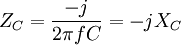
where:
 is the capacitive reactance,
 is the angular frequency,
f = input frequency,
C = capacitance in farads, and
 is the imaginary unit.
While this relation (between the frequency domain voltage and current associated with a capacitor) is always true, the ratio of the time domain voltage and current amplitudes is equal to  only for sinusoidal (AC) circuits in steady state.
only for sinusoidal (AC) circuits in steady state.
See derivation Deriving capacitor impedance.
Hence, capacitive reactance is the negative imaginary component of
impedance. The negative sign indicates that the current leads the
voltage by 90° for a sinusoidal signal, as opposed to the inductor,
where the current lags the voltage by 90°.
The impedance is analogous to the resistance of a resistor. The impedance of a capacitor is inversely proportional
to the frequency -- that is, for very high-frequency alternating
currents the reactance approaches zero -- so that a capacitor is nearly a
short circuit
to a very high frequency AC source. Conversely, for very low frequency
alternating currents, the reactance increases without bound so that a
capacitor is nearly an open circuit to a very low frequency AC source.
This frequency dependent behaviour accounts for most uses of the
capacitor (see "Applications", below).
Reactance is so called because the capacitor doesn't dissipate power,
but merely stores energy. In electrical circuits, as in mechanics,
there are two types of load, resistive and reactive. Resistive loads
(analogous to an object sliding on a rough surface) dissipate the energy
delivered by the circuit, ultimately by electromagnetic emission (see Black body radiation),
while reactive loads (analogous to a spring or frictionless moving
object) store this energy, ultimately delivering the energy back to the
circuit.
Also significant is that the impedance is inversely proportional to
the capacitance, unlike resistors and inductors for which impedances are
linearly proportional to resistance and inductance respectively. This
is why the series and shunt impedance formulae (given below) are the
inverse of the resistive case. In series, impedances sum. In parallel,
conductances sum.
Persamaan Laplace (widang s)
When using the Laplace transform in circuit analysis, the capacitive impedance is represented in the s domain by:

where C is the capacitance, and s (= σ+jω) is the complex frequency.
Kapasitor jeung arus nu pindah
The physicist James Clerk Maxwell invented the concept of displacement current, dD/dt, to make Ampere's law
consistent with conservation of charge in cases where charge is
accumulating as in a capacitor. He interpreted this as a real motion of
charges, even in vacuum, where he supposed that it corresponded to
motion of dipole charges in the ether. Although this interpretation has been abandoned, Maxwell's correction to Ampere's law remains valid.
Jaringan kapasitor
Susunan séri jeung paralél
Capacitors in a parallel configuration each have the same potential difference (voltage). Their total capacitance (Ceq) is given by:


The reason for putting capacitors in parallel is to increase the
total amount of charge stored. In other words, increasing the
capacitance also increases the amount of energy that can be stored. Its
expression is:

The current through capacitors in series
stays the same, but the voltage across each capacitor can be different.
The sum of the potential differences (voltage) is equal to the total
voltage. Their total capacitance is given by:


In parallel the effective area of the combined capacitor has
increased, increasing the overall capacitance. While in series, the
distance between the plates has effectively been increased, reducing the
overall capacitance.
In practice capacitors will be placed in series as a means of
economically obtaining very high voltage capacitors, for example for
smoothing ripples in a high voltage power supply. Three "600 volt
maximum" capacitors in series, will increase their overall working
voltage to 1800 volts. This is of course offset by the capacitance
obtained being only one third of the value of the capacitors used. This
can be countered by connecting 3 of these series set-ups in parallel,
resulting in a 3x3 matrix of capacitors with the same overall
capacitance as an individual capacitor but operable under three times
the voltage. In this application, a large resistor
would be connected across each capacitor to ensure that the total
voltage is divided equally across each capacitor and also to discharge
the capacitors for safety when the equipment is not in use.
Another application is for use of polarized capacitors in alternating
current circuits; the capacitors are connected in series, in reverse
polarity, so that at any given time one of the capacitors is not
conducting.
Dualitas kapasitor/induktor
In mathematical terms, the ideal capacitor can be considered as an inverse of the ideal inductor,
because the voltage-current equations of the two devices can be
transformed into one another by exchanging the voltage and current
terms. Just as two or more inductors can be magnetically coupled to make
a transformer, two or more charged conductors can be electrostatically coupled to make a capacitor. The mutual capacitance
of two conductors is defined as the current that flows in one when the
voltage across the other changes by unit voltage in unit time.
Panerapan
| Capacitor | Polarized capacitors |
Variable capacitor |
|---|---|---|
 |
    |
 |
Capacitors have various uses in electronic and electrical systems.
Panyimpenan énérgi
A capacitor can store electric energy when disconnected from its charging circuit, so it can be used like a temporary battery.
Capacitors are commonly used in electronic devices to maintain power
supply while batteries are being changed. (This prevents loss of
information in volatile memory.)
Capacitors are used in power supplies where they smooth the output of a full or half wave rectifier. They can also be used in charge pump circuits as the energy storage element in the generation of higher voltages than the input voltage.
Capacitors are connected in parallel with the power circuits of most
electronic devices and larger systems (such as factories) to shunt away
and conceal current fluctuations from the primary power source to
provide a "clean" power supply for signal or control circuits. Audio
equipment, for example, uses several capacitors in this way, to shunt
away power line hum before it gets into the signal circuitry. The
capacitors act as a local reserve for the DC power source, and bypass AC
currents from the power supply. This is used in car audio applications, when a stiffening capacitor compensates for the inductance and resistance of the leads to the lead-acid car battery.
Koréksi faktor daya
Capacitors are used in power factor correction. Such capacitors often come as three capacitors connected as a three phase load. Usually, the values of these capacitors are given not in farads but rather as a reactive power in volt-amperes reactive (VAr). The purpose is to counteract inductive loading from electric motors and fluorescent lighting in order to make the load appear to be mostly resistive.
Filter
Kopling sinyal
Because capacitors pass AC but block DC signals
(when charged up to the applied dc voltage), they are often used to
separate the AC and DC components of a signal. This method is known as AC coupling. (Sometimes transformers are used for the same effect.) Here, a large value of capacitance, whose value need not be accurately controlled, but whose reactance
is small at the signal frequency, is employed. Capacitors for this
purpose designed to be fitted through a metal panel are called
feed-through capacitors, and have a slightly different schematic symbol.
Filter noise, motor starter, jeung snubber
When an inductive circuit is opened, the current through the
inductance collapses quickly, creating a large voltage across the open
circuit of the switch or relay. If the inductance is large enough, the
energy will generate a spark, causing the contact points to oxidize,
deteriorate, or sometimes weld together, or destroying a solid-state
switch. A snubber
capacitor across the newly opened circuit creates a path for this
impulse to bypass the contact points, thereby preserving their life;
these were commonly found in contact breaker ignition systems, for instance. Similarly, in smaller scale circuits, the spark may not be enough to damage the switch but will still radiate undesirable radio frequency interference (RFI), which a filter
capacitor absorbs. Snubber capacitors are usually employed with a
low-value resistor in series, to dissipate energy and minimize RFI. Such
resistor-capacitor combinations are available in a single package.
In an inverse fashion, to initiate current quickly through an
inductive circuit requires a greater voltage than required to maintain
it; in uses such as large motors, this can cause undesirable startup
characteristics, and a motor starting capacitor is used to store enough energy to give the current the initial push required to start the motor up.
Capacitors are also used in parallel to interrupt units of a high-voltage circuit breaker in order to equally distribute the voltage between these units. In this case they are called grading capacitors.
In schematic diagrams, a capacitor used primarily for DC charge
storage is often drawn vertically in circuit diagrams with the lower,
more negative, plate drawn as an arc. The straight plate indicates the
positive terminal of the device, if it is polarized (see electrolytic capacitor).
Pamrosésan sinyal
The energy stored in a capacitor can be used to represent information, either in binary form, as in DRAMs, or in analogue form, as in analog sampled filters and CCDs. Capacitors can be used in analog circuits as components of integrators or more complex filters and in negative feedback loop stabilization. Signal processing circuits also use capacitors to integrate a current signal.
Sirkuit tala
Capacitors and inductors are applied together in tuned circuits
to select information in particular frequency bands. For example, radio
receivers rely on variable capacitors to tune the station frequency.
Speakers use passive analog crossovers, and analog equalizers use
capacitors to select different audio bands.
In a tuned circuit such as a radio receiver, the frequency selected is a function of the inductance (L) and the capacitance (C) in series, and is given by:

Panerapan séjén
Panerapan sénsor
Most capacitors are designed to maintain a fixed physical structure.
However, various things can change the structure of the capacitor -- the
resulting change in capacitance can be used to sense those things.
Changing the dielectric: the effects of varying the physical and/or electrical characteristics of the dielectric can also be of use. Capacitors with an exposed and porous dielectric can be used to measure humidity in air.
Changing the distance between the plates: Capacitors are used to accurately measure the fuel level in airplanes. Capacitors with a flexible plate can be used to measure strain or pressure. Capacitors are used as the sensor in condenser microphones, where one plate is moved by air pressure, relative to the fixed position of the other plate. Some accelerometers use MEMS
capacitors etched on a chip to measure the magnitude and direction of
the acceleration vector. They are used to detect changes in
acceleration, eg. as tilt sensors or to detect free fall, as sensors
triggering airbag deployment, and in many other applications. Also some fingerprint sensors.
Pulsed power and weapons applications
Groups of large, specially constructed, low-inductance high-voltage capacitors (capacitor banks) are used to supply huge pulses of current for many pulsed power applications. These include electromagnetic forming, Marx generator , pulsed lasers (especially TEA lasers), pulse forming networks, radar, fusion research, and particle accelerators.
Large capacitor banks are used as energy sources for the exploding-bridgewire detonators or slapper detonators in nuclear weapons and other speciality weapons. Experimental work is under way using banks of capacitors as power sources for electromagnetic armour and electromagnetic railguns or coilguns.
Bahya jeung kaamanan kapasitor
Capacitors may retain a charge long after power is removed from a
circuit; this charge can cause shocks (sometimes fatal) or damage to
connected equipment. For example, even a seemingly innocuous device such
as a disposable camera flash unit powered by a 1.5 volt AA battery
contains a capacitor which may be charged to over 300 volts. This is
easily capable of delivering an extremely painful, and possibly lethal
shock.
Many capacitors have low equivalent series resistance
(ESR), so can deliver large currents into short circuits, and this can
be dangerous. Care must be taken to ensure that any large or
high-voltage capacitor is properly discharged before servicing the
containing equipment. For safety purposes, all large capacitors should
be discharged before handling. For board-level capacitors, this is done
by placing a bleeder resistor
across the terminals, whose resistance is large enough that the leakage
current will not affect the circuit, but small enough to discharge the
capacitor shortly after power is removed. High-voltage capacitors should
be stored with the terminals shorted, since temporarily discharged capacitors can develop potentially dangerous voltages when the terminals are left open-circuited.
Large oil-filled old capacitors must be disposed of properly as some contain polychlorinated biphenyls (PCBs). It is known that waste PCBs can leak into groundwater under landfills. If consumed by drinking contaminated water, PCBs are carcinogenic,
even in very tiny amounts. If the capacitor is physically large it is
more likely to be dangerous and may require precautions in addition to
those described above. New electrical components are no longer produced
with PCBs. ("PCB" in electronics usually means printed circuit board,
but the above usage is an exception.) Capacitors containing PCB were
labelled as containing "Askarel" and several other trade names.

Tidak ada komentar:
Posting Komentar